How to Choose the Best Inverter for Home Use to Maximize Efficiency?
Choosing the best inverter for home use is crucial for maximizing energy efficiency. Inverters convert direct current (DC) into alternating current (AC), essential for powering home appliances. The inverter market is expected to grow significantly, with projections indicating a CAGR of 12.3% from 2023 to 2030.
According to energy expert John Smith, "The right inverter can significantly reduce energy costs and enhance home efficiency." Selecting an inverter that meets specific household needs is vital. Features such as size, capacity, and efficiency ratings should be carefully considered. A mismatch can lead to increased energy loss and insufficient power supply.
Research shows that inverters with high efficiency ratings above 95% can save consumers substantial amounts in the long run. However, it is also essential to reflect on the installation and maintenance aspects. Poor installation can negate the benefits of a high-quality inverter. As technology evolves, the importance of making informed choices in the inverter sector cannot be overstated.
Understanding the Basics of Home Inverters: Types and Functionality
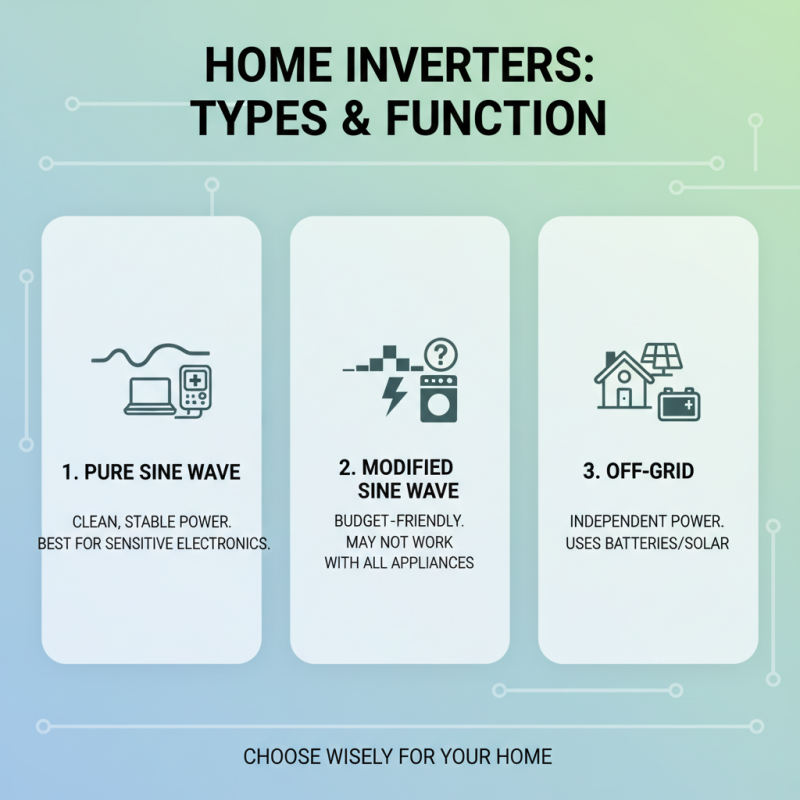
When selecting an inverter for home use, understanding the basics is crucial. There are several types of inverters available. The most common ones are pure sine wave inverters, modified sine wave inverters, and off-grid inverters. Pure sine wave inverters deliver clean, stable energy. They are best for sensitive devices like computers and medical equipment. Modified sine wave inverters are more budget-friendly. However, they may not be compatible with all appliances.
Tip: Determine the total wattage you need. Consider all electrical devices you intend to power. This calculation enables you to choose an inverter with the right capacity.
Inverters function by converting direct current (DC) into alternating current (AC). The AC is what most home appliances require. Off-grid inverters allow you to use solar energy efficiently. They provide the freedom to run devices independently from the grid. However, remember that these setups can be complex. They often require extra components like batteries and controllers.
Tip: Assess your energy needs. Think about daily usage patterns. This understanding helps you avoid overloading your inverter. If you choose an inverter that’s too small, it might not handle the load. Watch your appliances for warning signs.
In the end, striking a balance between your needs and the inverter type is key. Make the right choice to ensure efficiency and reliability.
Key Factors to Consider When Choosing an Inverter for Home Use
When choosing an inverter for home use, several key factors influence efficiency and reliability. One significant aspect is inverter type. Pure sine wave inverters are better for sensitive electronics. Modified sine wave inverters might work for basic appliances but can lead to inefficiency with complex devices.
Capacity also plays a crucial role. It must match your energy needs. Reports indicate that oversized inverters can lead to higher losses. According to the Energy Information Administration, a well-sized inverter ensures optimal performance, reducing wasted energy.
**Tip:** Calculate your total power requirements before purchasing. Accurate estimates prevent the frustration of underperformance or energy waste.
Efficiency ratings are important too. Look for inverters with high efficiency during low power usage. Inverters often operate less efficiently at their maximum load. A report by the National Renewable Energy Laboratory found that an inverter's average efficiency can be as low as 85% at full capacity.
**Tip:** Read reviews to understand real-world performance. Data can highlight potential issues or performance gaps that manufacturers may not disclose.
How to Choose the Best Inverter for Home Use to Maximize Efficiency
Evaluating Inverter Efficiency Ratings and Their Impact on Performance
When choosing an inverter for home use, efficiency ratings are crucial. These ratings directly affect how well the inverter converts DC to AC power. An efficient inverter wastes less energy, which equals lower electricity bills. A good efficiency rating often reflects quality. However, not every high-rated inverter performs well under different conditions.
Consider the inverter's load capacity. A unit that is too small may struggle under heavy loads. This could lead to overheating or reduced lifespan. Conversely, an oversized inverter might operate less efficiently at lower loads. It’s essential to find a balance. Investigate how efficiency varies across the inverter's operational range. Some models excel in specific scenarios but may underperform in others.
Don't forget to assess the inverter's features. Additional functionalities like automatic shutdown can protect your investment. However, they may also add complexity. Simplicity can sometimes be more effective. Take time to research and reflect on your specific needs. An informed choice leads to better performance and efficiency.
How to Choose the Best Inverter for Home Use to Maximize Efficiency?
| Inverter Type |
Efficiency Rating (%) |
Power Output (kW) |
Cooling Method |
Price Range (USD) |
| Pure Sine Wave |
90-95 |
1.5 - 3 |
Air-cooled |
400 - 800 |
| Modified Sine Wave |
70-85 |
1 - 2.5 |
Passive Cooling |
200 - 500 |
| Grid Tie Inverter |
95-98 |
3 - 10 |
Active Cooling |
800 - 2500 |
| Off-Grid Inverter |
85-90 |
1 - 5 |
Air-cooled |
500 - 1200 |
Assessing Power Needs: Calculating Demand for Your Household
Assessing power needs for your home is essential before choosing an inverter. Calculate the total wattage of appliances you plan to run during an outage. City data shows that an average household may require between 3,000 to 5,000 watts, depending on the number of devices. This range includes essentials like refrigerators, lights, and electronics.
To accurately gauge your demand, list all necessary appliances. Note their wattage, which is often available on a label. Add the starting wattage required for devices like air conditioners. This initial surge can be significantly higher than their running wattage. For instance, a 1,500-watt air conditioner may need up to 3,000 watts to start.
Tip: Keep a cushion in mind. It’s wise to account for future needs. Aim for an inverter with at least 20% higher capacity than your calculated demand. This margin ensures efficient operation under varying loads.
Remember, not all watts are created equal. Meeting power needs is vital, but efficiency is crucial too. Some inverters may seem appealing but can fall short in peak power performance. Take the time to research and compare specifications. A slightly more expensive option can be more economical in long-term energy savings.
Comparing Features and Price Points to Find the Best Value Inverter
When selecting an inverter for home use, it’s important to compare features and prices. Many inverters have built-in protection systems. These systems prevent overloads and short circuits. An inverter's efficiency rating is crucial. Look for something over 90% efficiency. Some models are noisy, which can be annoying. Consider noise levels before making a choice.
Price points vary significantly. You might find basic models starting under a certain amount. Mid-range options offer more features, while high-end units often include advanced functions. However, high prices don’t always guarantee better performance. Research is essential. Check user reviews and ratings. Feedback often reveals real-world performance.
Less-priced inverters may lack important features. Warranty terms are also worth considering. Some warranties cover parts only, while others are more comprehensive. Choose the best value by taking your time. Examine specifications closely and don't rush. It might be wise to create a list of what you truly need. Prioritize efficiency and durability over flashy features.