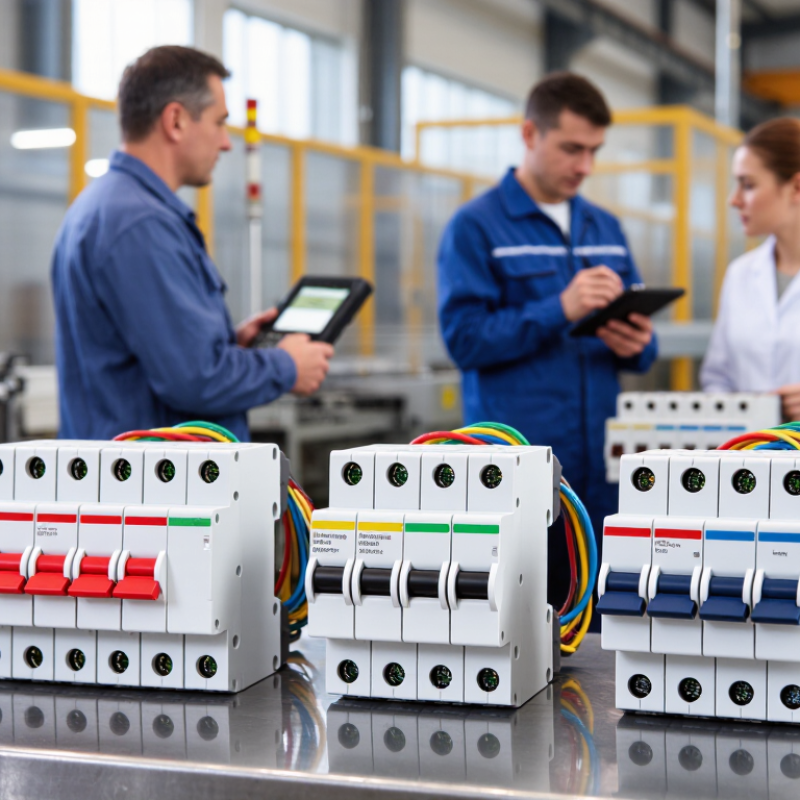
Choosing the best Smart Breaker supplier in China is not a simple search for the lowest quotation. It requires a close look at engineering capability, production discipline, testing methods, and after-sales support. A reliable supplier should explain its products clearly, from rated current and breaking capacity to communication options and overload protection. Factory visits can reveal practical details that brochures hide: calibrated test benches, traceable components, clean assembly lines, and technicians checking terminal torque. These details matter. They reduce uncertainty before a breaker enters a panel, building, or industrial site. Yet, no supplier is perfect. A polished website does not prove consistent quality, and one successful sample cannot represent every production batch.
This guide examines how buyers can compare Chinese Smart Breaker manufacturers with greater confidence. It considers certifications, product documentation, customization experience, delivery controls, warranty terms, and field feedback. Independent testing and factory audits remain valuable, especially when projects involve remote monitoring, energy management, or integration with existing systems. Buyers should confirm whether claimed standards match the destination market and installation environment. Price deserves attention, but it should not outweigh safety evidence or long-term service. In practice, the best supplier may be the one that answers difficult questions honestly, provides repeatable test records, and responds quickly when a prototype fails. That judgment takes time. It also requires reflection: are we selecting a dependable partner, or merely accepting an attractive offer? With careful, evidence-based comparison, buyers can identify a supplier that supports safer installations and more predictable performance.
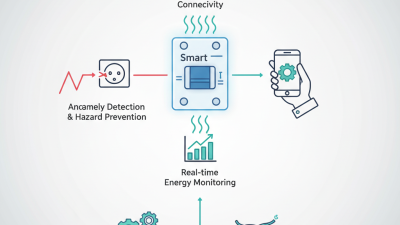
A smart breaker is more than a remotely controlled switch. It combines circuit protection, sensors, and a communication module. Current sensors measure load changes inside the panel. A microcontroller compares those readings with preset limits. If current rises dangerously, the breaker trips like a conventional device. It may also detect leakage, overheating, or abnormal voltage. The mechanism remains familiar.
Communication adds visibility. A homeowner can view energy use, receive overload alerts, or disconnect a circuit remotely. However, remote control does not replace local protection. During practical commissioning, weak wireless signals and incorrect settings still cause problems. That detail is easy to overlook.
The International Energy Agency’s Electricity 2024 report forecasts global electricity demand to grow by about 4% in 2024 and 2025. More connected loads make circuit-level monitoring increasingly useful. The IEA’s Digitalisation and Energy report also projected nearly 50 billion connected devices by 2020, showing the scale of networked equipment growth. Safety remains the priority. The NFPA Home Structure Fires report found electrical distribution and lighting equipment involved in 57% of home fires caused by electrical failure or malfunction during 2015–2019. For buyers comparing Chinese suppliers, request test records, communication specifications, thermal data, and cybersecurity documentation. A lower price can hide weaker sensors or limited support. Smart does not always mean dependable.
What Is the Best Smart Breaker Supplier in China?
A reliable smart breaker supplier should prove performance, not just present attractive brochures. In field projects, I check overload protection, short-circuit response, temperature control, and remote switching accuracy. The device should continue working after repeated load changes. Small details matter, such as clear terminal labels and firm communication connections.
Testing evidence is essential. Ask for factory test records, sample reports, calibration procedures, and traceable production batches. A professional supplier should explain which standards the breaker follows and how each model is inspected. Certifications alone are not enough. I have seen documents that looked complete but lacked useful test conditions. That gap deserves careful questioning.
Technical support also defines reliability. Engineers should help with wiring diagrams, communication protocols, fault settings, and installation training. Response time matters when a breaker trips during a busy production shift. Check whether spare parts, firmware updates, and repair procedures are available for several years. Data security should receive attention when breakers connect to cloud platforms or building systems. Some suppliers promise quick customization, yet poorly documented changes can create future problems. A dependable supplier records every revision and provides practical samples before mass production. The best choice may not be the cheapest one. It is the supplier whose claims survive testing, inspection, and daily use.
A practical, brand-neutral evaluation framework for comparing smart circuit-breaker suppliers. The benchmarks below are based on commonly used electrical safety standards, procurement requirements, and verifiable supplier-performance indicators.
| Evaluation Dimension | Weight | Reliable Supplier Benchmark | Recommended Verification Data | Suggested Rating | Priority |
|---|---|---|---|---|---|
| Product Safety Compliance | 20% | Products should be tested against the applicable standard, such as IEC 60898-1 for household circuit-breakers, IEC 60947-2 for low-voltage circuit-breakers, or UL 489 where North American certification is required. | Valid certificates, test reports from recognized laboratories, rated current, rated voltage, short-circuit capacity, insulation voltage, and operating-temperature specifications. | Critical | Very High |
| Electrical Protection Functions | 15% | The product should clearly define overload, short-circuit, over-voltage, under-voltage, leakage, or over-temperature protection according to the selected model. | Protection curves, trip-time data, leakage-current threshold, temperature-rise results, product datasheets, and independent laboratory test records. | Critical | Very High |
| Rated Performance | 12% | Rated current, voltage, frequency, pole configuration, and breaking capacity must match the intended installation. A breaking-capacity value such as 6 kA or 10 kA must be stated, not implied. | Technical datasheet, nameplate photographs, sample inspection, type-test report, and third-party verification of electrical parameters. | Critical | Very High |
| Communication Reliability | 10% | The supplier should document the communication method, supported network topology, data refresh behavior, offline operation, and recovery after power or network interruption. | Communication protocol documentation, API or SDK information, gateway specifications, packet-loss test results, reconnection logs, and interoperability test records. | High | High |
| Cybersecurity and Data Control | 8% | Connected products should use authenticated access, encrypted communication where applicable, role-based permissions, secure firmware management, and a defined data-retention policy. | Security architecture, password policy, encryption description, vulnerability-response process, firmware-update procedure, and cloud data-location statement. | High | High |
| Manufacturing Quality System | 10% | A mature factory should operate documented quality controls covering incoming materials, assembly, calibration, aging, final inspection, traceability, and corrective action. | Quality-management certificate, process-control plan, inspection records, calibration certificates, batch traceability, defect-rate data, and factory-audit results. | High | High |
| Testing and Validation Capacity | 8% | The supplier should maintain or access facilities for temperature-rise, endurance, insulation, dielectric-strength, mechanical-operation, communication, and environmental testing. | Equipment list, test procedures, test frequency, sample reports, laboratory accreditation details, and product-validation records. | High | High |
| Customization Capability | 5% | The supplier should be able to adapt enclosure dimensions, pole configuration, current rating, communication method, interface language, packaging, and firmware features without compromising certification. | Engineering-change procedure, minimum order quantity, development timeline, prototype process, firmware-release records, and sample customization project. | Medium | Medium |
| Supply Capacity and Lead Time | 5% | The supplier should provide a realistic production capacity, component-sourcing plan, standard lead time, peak-season plan, and continuity strategy for critical electronic components. | Capacity statement, production schedule, historical on-time-delivery data, bill-of-materials risk review, and business-continuity plan. | Medium | Medium |
| Warranty and After-Sales Support | 4% | A dependable supplier should provide written warranty terms, replacement procedures, technical response times, firmware support, and an escalation process for safety-related issues. | Warranty policy, service-level agreement, response-time commitment, spare-parts policy, failure-analysis procedure, and customer-support contact structure. | High | Medium |
| Documentation and Traceability | 3% | All products should have consistent model numbers, revision control, installation instructions, wiring diagrams, safety warnings, and batch identification. | User manual, installation guide, declaration documents, label samples, revision history, QR or serial-number traceability, and packaging inspection. | Medium | Medium |
What Is the Best Smart Breaker Supplier in China?
How to Compare China’s Leading Smart Breaker Manufacturers
Choosing a smart breaker supplier in China requires more than comparing unit prices. Examine product design, factory controls, testing methods, and after-sales support. A reliable manufacturer should provide clear ratings for current, voltage, breaking capacity, and communication protocols. Ask for test reports that match the exact model, not a similar product. Small details matter.
Factory experience becomes visible during an audit. Look at assembly lines, calibration equipment, insulation testing, and final inspection records. Ask how the manufacturer handles overload protection, temperature rise, remote switching, and fault notifications. Request samples from regular production, rather than specially prepared units. This reveals consistency.
No supplier is perfect. A polished catalog can still hide weak documentation or slow technical support. One easy mistake is trusting certifications without checking their scope and validity. Compare warranty terms, software update policies, replacement procedures, and response times. Also review enclosure quality, terminal strength, labeling, and installation instructions. These details affect electricians and end users directly.
Price should remain important, but it should not lead the decision. A cheaper breaker may require more field testing, troubleshooting, or replacement stock. Ask for production lead times and realistic monthly capacity. Verify whether engineering staff can adapt settings without compromising safety. A dependable supplier answers difficult questions clearly, even when the answer is inconvenient.
This reference benchmark uses commonly specified ratings for DIN-rail smart breakers in the China market: 230 V AC rated voltage, 63 A rated current, 50 Hz frequency, and 6 kA short-circuit capacity. Buyers should verify certification, protection functions, communication protocols, temperature range, warranty, and test reports in each supplier’s technical datasheet.
What Is the Best Smart Breaker Supplier in China?
A reliable smart breaker supplier should prove compliance, not merely display certificates. Ask for valid CCC approval where applicable, ISO 9001 quality records, and test reports linked to the exact model. The product’s ratings should match IEC 60947-2, IEC 61008-1, or IEC 61009-1 requirements, depending on its function. CE documentation and RoHS declarations also need clear technical files, not copied logos.
Look closely at the evidence. Is the certificate current? Does it show the factory address, product range, and rated current? Request routine test records, calibration certificates, sample test results, and traceable serial numbers. A supplier should explain short-circuit testing, temperature-rise testing, communication stability, and trip accuracy. Real factory experience matters. Ask to inspect a production line, even by live video.
Service quality deserves equal attention. The IEA Electricity 2024 report expects global electricity demand to grow by 3.3% in 2024 and 3.7% in 2025. More connected loads increase the need for dependable monitoring and rapid support. Choose suppliers offering firmware updates, protocol integration, installation guidance, spare parts, and a written warranty. Cybersecurity checks should cover password control, access permissions, and secure updates. IEC 62443 principles can guide industrial deployments. Some suppliers promise everything. Their manuals may tell another story. Request a pilot batch and measure nuisance trips, data accuracy, and response time before committing.
What Is the Best Smart Breaker Supplier in China?
How to Select the Best Supplier for Your Project?
Choosing a smart breaker supplier requires more than comparing catalog prices. IEA’s Electricity 2024 report forecasts global electricity demand to grow by an average of 3.4% annually through 2026. This pressure makes accurate monitoring and dependable protection increasingly valuable. Define your voltage, current, breaking capacity, communication protocol, and installation environment before contacting suppliers. A clear specification prevents attractive but unsuitable quotations.
Check test evidence, not only certificates. Ask for reports covering IEC 60898-1 or IEC 60947-2, temperature rise, short-circuit endurance, and remote-trip performance. Request serial-number traceability and calibration records. The supplier should explain firmware updates, data security, and failure recovery in plain language. Vague answers are a warning sign. Product samples should survive realistic cabinet conditions, including heat, dust, and repeated switching.
A capable supplier also supports engineering after delivery. Ask for wiring diagrams, API documentation, commissioning guidance, and a defined response time. The U.S. Department of Energy’s Virtual Power Plants report estimates 80–160 GW of potential capacity by 2030. Smart breakers can support this flexibility, but only when measurements remain stable and accessible. Compare total ownership cost, including gateways, software fees, spare units, and training. A low quote can still be expensive. In project reviews, I have found that pilot testing exposes weaknesses earlier than factory presentations. No supplier is perfect; your evaluation process should admit that.